



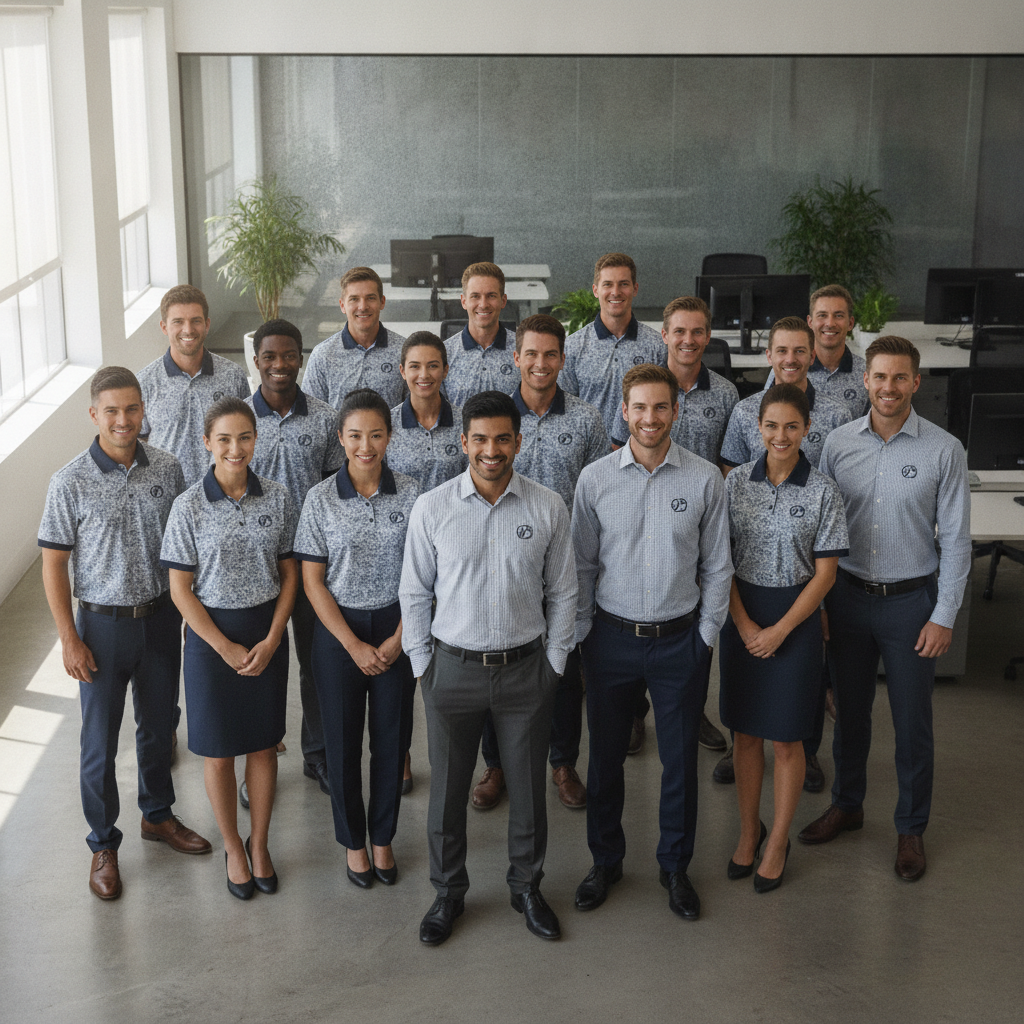
Custom corporate uniforms for office staff are coordinated apparel systems that align brand colors, logo placement, and role-specific garments to create a consistent, professional look. In New Delhi, Kapair T-shirt designs, manufactures, and ships end-to-end office uniform kits—covering fabric selection, logo embroidery/printing, sampling, and logistics for B2B teams across Delhi NCR and India.
By Dev Kapair • Last updated: 2026-06-24
Above-Fold Section: Hook + Table of Contents
This complete guide walks HR, admin, and procurement leaders through planning, sourcing, and rolling out office uniforms that look sharp and last. You’ll see how to choose fabrics, fits, and logo methods, build a frictionless approval flow, and standardize reorders so every new hire matches your original standard.
- Quick Summary
- What Is Custom Corporate Uniforms for Office Staff?
- Why Uniforms Matter
- How a Uniform Program Works
- Garment Types + Decoration Methods
- Best Practices
- Tools and Resources
- Case Studies and Examples
- FAQ
- Conclusion + Next Steps
Quick Summary
An effective office-uniform program balances brand control with employee comfort. Start with breathable fabrics, inclusive fits, and the right logo technique (embroidery, screen, DTF, or sublimation). Lock a master approval, then streamline sizing, packaging, and reorders to keep teams consistent through seasons, new hires, and departmental changes.
Uniforms are a daily brand touchpoint. When polos, shirts, and tees fit well and the logo stays crisp, employees feel confident and customers instantly recognize your team. Our New Delhi production hub coordinates fabric, decoration, and logistics so your program scales without chaos.
For deeper garment selection guidance, see our comparison on choosing between knit and woven staples in polo shirts vs. round-neck T-shirts, and explore our dedicated corporate uniforms resources in the Corporate pillar.
What Is “Custom Corporate Uniforms for Office Staff”?
Custom corporate uniforms for office staff are branded apparel systems—polo shirts, formal shirts, tees, and light outerwear—built around your color palette, logo rules, and role needs. The aim is a unified, comfortable look that withstands frequent wear and washing while enhancing brand recognition.
Think of uniforms as a program, not a one-off buy. It blends role mapping (front desk, sales, operations), garment choices (polo, button-down, knit tee, wind jacket), and decoration (embroidery, screen, DTF, sublimation). The right mix delivers consistency without restricting movement or comfort in air-conditioned offices.
- Role mapping: Client-facing roles often wear polos or formal shirts; back-office teams prefer soft knits.
- Brand control: Lock Pantone references, placements, and size rules so every reorder matches.
- Care and longevity: Choose fabrics and decoration that resist fading, cracking, and puckering.
At Kapair T-shirt, we combine fabric selection, design proofing, sampling, production, and logistics in New Delhi. That single-thread workflow reduces rework and keeps bulk and small-batch runs aligned—whether you’re outfitting 20 or 2,000 employees.
Why Office Uniforms Matter
Uniforms sharpen brand recognition, clarify dress expectations, and boost team belonging. For HR and procurement, they simplify onboarding and reorders, reducing fragmented purchases and dress-code back-and-forth—while ensuring consistent quality across seasons and suppliers.
First impressions form fast. A clean, consistent look signals reliability before a word is spoken. Kits also reduce “what to wear” friction and help new hires feel included from day one. Meanwhile, procurement benefits from a defined SKU set and a clear reorder cadence.
- Brand consistency: Repeated exposure to the same colors and marks improves recall.
- Employee comfort: Breathable knits and wrinkle-resistant wovens support long office days.
- Operational clarity: Kits remove ambiguity in dress codes and accelerate replacements.
- Decoration durability: Method-to-fabric matching prevents early cracking or fading.
In our experience, pilot wear-wash tests with 10–20 employees surface 80% of fit and placement tweaks before production. That single loop often saves an entire round of rework.
How a Uniform Program Works (Step-by-Step)
Great programs follow a clear arc: discovery, fabric and fit selection, decoration choice, proofing, sampling, production, and logistics. Each step validates comfort and brand accuracy before scale—cutting delays and keeping launches on time.
- Discovery: Define roles, climate, office culture, and brand rules. Capture accommodation needs and any safety constraints for hybrid roles.
- Fabric + fit: Use cotton-rich knits for polos/tees and wrinkle-resistant blends for shirts. Offer men’s and women’s fits with an inclusive size range.
- Decoration method: Map artwork to embroidery, screen, DTF, or sublimation based on detail level and fabric.
- Design proofing: Approve logo placements and Pantone matches on a master template to prevent drift.
- Sampling: Test a size set; run a quick wear-wash for colorfastness and comfort notes.
- Production: Execute printing/embroidery; QA stitch density, registration, alignment, and thread trims.
- Logistics: Pick-pack by department, label sizes, include care cards, and establish a reorder path.
Kapair’s end-to-end model in New Delhi keeps these phases under one roof. That alignment—especially between fabric and decoration—prevents mismatches like large satin-stitch logos on ultra-light knits or sublimation requests on cotton tees.
For a deeper dive into customizing in the region, explore our localized overview of customizing corporate uniforms in Delhi, and see how we standardize onboarding SKUs in office-uniform T-shirts supplier in Delhi.
Garment Types and Decoration Methods
Choose garments by role and climate, then match the logo method to fabric and artwork. Polos and formal shirts cover most client-facing work; round-neck tees and lightweight outerwear serve daily comfort. Embroidery is premium for small marks; screen, DTF, and sublimation handle color-rich designs.
Pillar garments for office teams
Most office programs rely on two kits: a polished, woven look for client-facing work and a knit-based set for daily comfort. Both share the same colorway and mark rules so teams look unified at a glance.
- Polo shirts: Breathable, structured collar; versatile with chinos or slacks. See fit notes in our polo vs. tee comparison.
- Formal shirts: Button-downs for leadership and sales calls where crisp structure signals polish.
- Round-neck tees: Soft base layers for back office or casual Fridays; ideal for internal campaigns.
- Light jackets/windbreakers: Outer layer for monsoon commutes and cool office A/C zones.
- Hoodies/sweatshirts: Culture pieces for tech and creative teams; ideal for winter layering.
Decoration method comparison
| Method | Best For | Durability | Hand-Feel | Color Range | Ideal Fabrics |
|---|---|---|---|---|---|
| Embroidery | Small chest logos | High | Premium, textured | Solid shades | Polos, shirts, jackets |
| Screen printing | Bold spot colors | High | Soft (water-based) | Excellent | Cotton tees, polos |
| DTF printing | Fine detail + gradients | High | Flexible film | Photoreal/gradients | Many knits/wovens |
| Sublimation | Edge-to-edge color | Very high | No feel (dyed-in) | Excellent | Polyester blends |
Example pairings: a reception polo with a 3–3.5 cm embroidered chest mark; an internal campaign tee with DTF for gradient fidelity; or a conference crew tee with bold screen-printed spot colors.
Helpful context on common uniform categories appears in retail ecosystems as well; for instance, Shopify’s uniform overview outlines how buyers typically group categories and use-cases. While your procurement goals differ from retail, those patterns can help align internal stakeholders.

Best Practices for a Reliable Office-Uniform Program
Document brand rules, pick breathable fabrics, and test a size set before production. Keep placements consistent, share care guidance, and maintain a simple reorder path. These habits reduce rework, improve comfort, and keep teams on-brand week after week.
Fit, fabric, and comfort
Employees wear uniforms for long stretches, so comfort drives adoption. Get these three right to avoid exchanges and disengagement.
- Breathable knits: Cotton-rich or performance blends handle hot months and cool offices.
- Inclusive sizing: Offer a full range with tailored men’s/women’s cuts; validate sleeve and hem lengths.
- Wrinkle resistance: Blended shirtings retain structure from desk to meeting.
Brand rules that prevent drift
Most consistency issues trace back to unclear rules. A single-page spec averts years of micro-variation.
- Anchored placements: Fix chest logo size and distance from placket or side seam.
- Color control: Pantone-match threads and inks; standardize acceptable base colors.
- Template approvals: One master proof should govern every reorder and variant.
Care, packaging, and reorders
Rollouts go smoother when the last mile is planned. Your HR team will thank you.
- Clear care tags: Simple wash guidance preserves color and print longevity.
- Department packs: Pick-pack by team with visible size labels to speed handover.
- Replenishment flow: Keep a small buffer of common sizes and document the reorder contact path.
Local considerations for New Delhi
- Choose moisture-managing knits for peak summer and use airier fits to improve comfort.
- Plan monsoon-friendly outer layers (light wind jackets) for commutes between buildings.
- Schedule sampling and approvals ahead of major local holidays to secure production windows.
Curious about premium finishing options? Our premium corporate uniforms overview shows how fabric and stitch upgrades can elevate an otherwise standard kit without overcomplicating care.
Plan your rollout with a 20-minute consult. Share your roles, brand files, and target launch date. We’ll assemble swatches, a size set, and a placement proof so you can approve once and scale with confidence.
Explore our standardized process for custom corporate uniforms and how we support staged launches across departments.
Tools and Resources (What We Provide)
Projects move faster with the right tools: size charts, swatches, Pantone references, and annotated proofs. Kapair supplies measurement sets, digital approvals, and department-wise packing lists so HR and admin teams can launch without last-minute surprises.
- Size and fit kits: Try-ons for common sizes to reduce exchange loops.
- Fabric swatch books: Compare weights and hand-feel across cotton, blends, and performance knits.
- Color standards: Pantone references for threads and inks; base-color guidance for garments.
- Artwork templates: Placement grids for polos, shirts, tees, and jackets.
- Digital approvals: E-mailed proofs with annotations; one file becomes the standard.
- Packing and labeling: Department-wise lists, size labels, and a simple reorder note.
We keep printing and embroidery in-house—screen printing, DTF, sublimation, and embroidery—so fabric choices and logo methods align early. That integration minimizes trial-and-error and speeds sign-off.
Case Studies and Real-World Examples
Uniforms succeed when they match role demands. See how polos, formal shirts, tees, and outerwear combine for front office, operations, and event teams—each with decoration tuned to fabric and artwork for long-term wear.
Front office and reception
Goal: premium, consistent first impression without sacrificing comfort during long desk shifts.
- Garments: Polo + light wind jacket for seasonal cover.
- Decoration: Embroidered left-chest logo; optional initials on sleeve.
- Result: Clean silhouette and durable mark that holds up to daily wear.
Back office and support
Goal: breathable comfort with optional branding for meeting-heavy days.
- Garments: Round-neck tees as the base; optional overshirt.
- Decoration: DTF or screen for detail-rich internal graphics.
- Result: Team identity without heavy hand-feel or restrictive fits.
Sales and leadership
Goal: crisp structure for presentations and external meetings.
- Garments: Formal shirts with wrinkle resistance.
- Decoration: Small, neat embroidery for subtle branding.
- Result: Polished presence that aligns with brand tone without distraction.
Looking for personalization ideas that keep standards intact? Our New Delhi team documents placement grids and thread/ink specs in your master file—mirroring processes used in our personalized office uniforms playbook.
Broader officewear style patterns can also provide reference points when you’re briefing stakeholders. For inspiration on restrained, office-appropriate silhouettes, review a curated “classics” set like this office-appropriate collection to align on vibe—then translate that direction into standardized, reproducible uniforms.
Frequently Asked Questions
Most teams ask about fabrics, logo techniques, and rollout timelines. These answers help you plan with confidence and avoid sizing, approval, and reorder pitfalls.
What fabrics work best for office uniforms?
Cotton-rich knits suit polos and tees for breathability, while blended shirtings hold structure for formal looks. For outerwear, pick lightweight windbreakers that layer over office wear. Prioritize comfort, colorfastness, and easy care across categories.
Which logo method should we choose?
Use embroidery for small chest logos and a premium, textured look. Choose screen printing for bold spot colors, DTF for gradients and fine detail, and sublimation for color-intense polyester pieces. Match method to fabric and artwork for durability and comfort.
How do we manage sizing and exchanges?
Run a try-on with a size set before production and lock a size chart for reorders. Clear labeling on department packs and a documented exchange window prevent confusion during rollout and onboarding waves.
Can we launch in phases?
Yes. Many teams outfit client-facing roles first, then extend to back office. Use one master approval file so future runs match your original placements and color standards.
Conclusion and Next Steps
Uniform programs succeed when fabric, fit, decoration, and logistics pull together. Start with discovery, approve one visual template, test a size set, and scale with a simple reorder path. That’s how teams stay comfortable and on-brand—day after day.
Key takeaways you can action this week:
- Map roles to two simple kits: woven-formal and knit-daily, in one colorway.
- Match decoration to fabric and artwork—embroidery for small marks; DTF/screen for color complexity.
- Approve a master template once; use it for all reorders and variants.
- Plan packaging by department and publish a short care guide.
Ready to plan custom corporate uniforms for office staff? Book a quick consult with our New Delhi team. We’ll align garments, decoration, and rollout so your first delivery becomes the long-term standard.
When aligning senior stakeholders on silhouette and formality, a general wardrobe-planning lens can help. This primer on executive attire offers a helpful framing for consistent office looks: executive wardrobe considerations.

