



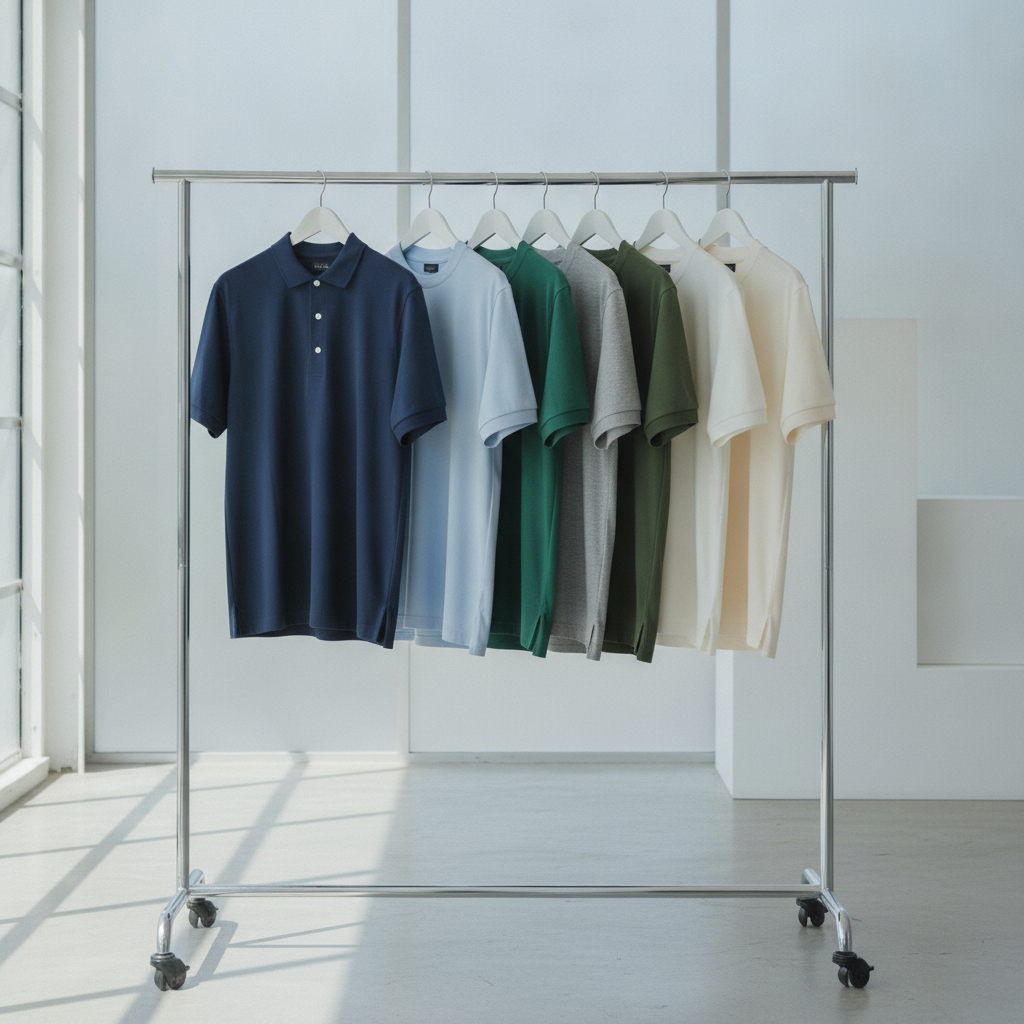
Polo shirts vs round neck t-shirts is a practical style decision for corporate apparel in New Delhi. Polos add a collared, semi-formal look that suits client-facing roles and embroidery. Round neck tees maximize comfort and print area for events and teams. Decide by dress code, branding method, fabric, and climate.
By Dev Kapair — Kapair T-Shirt
Last updated: 2026-06-23
Overview
Polos and round neck tees serve different corporate needs. Polos project a refined, collared profile that fits semi-formal dress codes and chest embroidery. Round neck t-shirts offer light, breathable comfort and large print areas for events. Balance brand image, fabric weight (GSM), and decoration method to choose well.
Kapair T-Shirt manufactures both styles end to end for B2B teams across Delhi NCR. We handle fabric selection, design proofing, screen printing, DTF, sublimation, embroidery, and final logistics. This guide translates factory-floor experience into a simple, decision-ready comparison grounded in how apparel performs after months of real use.
- Prefer polos when: teams meet clients, reception needs polish, or uniforms must hold structure all day.
- Prefer tees when: you need big artwork for events, summer activations, or all-day comfort on the floor.
- Branding fit: polos favor embroidery and subtle chest logos; tees excel with bold screen or DTF prints.
- Fabric ranges: polos often use pique or interlock at about 200–210 GSM; tees use single jersey near 160–180 GSM.
Quick Comparison Table
Use this table to match style to purpose fast. Polos elevate brand presence and pair best with embroidery, while round neck tees maximize comfort, print area, and unit efficiency for large groups. Scan the rows to align dress code, climate, and branding needs within minutes.
| Criteria | Polo Shirts | Round Neck T-Shirts |
|---|---|---|
| Look & Dress Code | Collared, semi-formal; ideal for client-facing roles | Casual, relaxed; ideal for events and teams |
| Common Fabric & GSM | Pique or interlock; about 200–210 GSM for structure | Single jersey; about 160–180 GSM for breathability |
| Branding Methods | Embroidery, small chest logos; subtle screen/DTF | Screen, DTF, sublimation (poly); full-front/back prints |
| Print Area | Moderate; collar and placket limit large graphics | Large; uninterrupted canvas for artwork/messages |
| Climate Comfort | Good airflow in pique; collar adds sun coverage | Maximum airflow; cooler in crowded events |
| Longevity in Uniforms | High; collar resists sag with proper care | High with 180–200 GSM; mid with lighter fabrics |
| Best For | Corporate uniforms, reception, premium gifting | Promotions, marathons, tech nights, campus drives |
In production terms, chest embroidery on polos often ranges from roughly 5,000 to 12,000 stitches for a 3 to 3.5-inch logo. Screen or DTF prints on tees commonly span 8 to 12 inches wide for readability in photos and across mixed sizes from XS to 3XL.

Round neck tees minimize seam interference, enabling consistent 12-by-14-inch placements on the front or back. Polos, with collars and plackets, excel with compact logos on the left chest (about 3.25 inches) or sleeve crests near 2 inches diameter for department or partner marks.
Our Top Pick
If you must choose one core corporate style, pick a premium polo for client-facing teams. A collared knit with ribbed cuffs, a two-button placket, and a clean chest embroidery delivers sharp, durable branding that stays polished through dozens of wash cycles with standard care.
Why polos win as a default uniform: the collar frames ID lanyards cleanly, the placket keeps shape, and breathable pique handles humid days without clinging. With subtle left-chest embroidery, even a 1.8-inch monogram looks executive in company photos, on reception, and during walk-ins.
- Polished daily wear: 1×1 rib on collar and cuffs resists flare better than jersey collars.
- Embroidery-first branding: thread depth adds tactility; 5k–12k stitches keep edges crisp on repeat wear.
- Uniform consistency: collar and placket create a consistent silhouette across sizes for group shots.
- Faster approvals: standardized placements reduce design loops, accelerating bulk dispatch timelines.
For mixed-duty teams in New Delhi that split time between office floors and client demos, one strong polo program keeps everyone photo-ready. See our local capability pages: polo manufacturers in Delhi and polo T-shirt manufacturer in Delhi.
Best Picks for 10 Real-World Scenarios
Match style to use case. Choose polos for semi-formal, client-facing, or recurring uniform needs. Choose round neck tees for large events, hot-weather field work, or big artwork. Use GSM, print method, and care plans to fine-tune durability, comfort, and brand consistency.
1) Executive reception and client demos — Pick a polo
- Why: a collared silhouette signals polish during walk-ins and presentations.
- Spec: pique knit near 210 GSM; two-button placket; left-chest embroidery about 3.2 inches wide.
- Bonus: sleeve crests (about 2 inches) carry department or partner marks.
We standardize thread recipes to keep logo color consistent across reorders, so teams scale without visible shade drift. For corporate rollouts, review our corporate polo supplier in Delhi NCR capabilities.
2) Tech hackathons and night shifts — Pick a round neck tee
- Why: single jersey breathes and moves; a crew neck feels distraction-free at keyboards.
- Spec: about 170 GSM cotton blend for 12-to-16-hour wear; screen or DTF prints at 10–12 inches wide.
- Bonus: tagless heat-transfer labels reduce irritation during long sprints and overnight work.
Teams often rotate three tee colors to separate staff roles. We adjust color blocking so artwork stays legible under mixed lighting without overpowering photography.
3) Outdoor summer activations — Pick a round neck tee
- Why: lighter GSM and no collar mean less trapped heat and better airflow in crowds.
- Spec: about 160–170 GSM; wicking blends for field teams; bold front and back prints for visibility at 20–25 feet.
- Bonus: cap pairing for sun coverage; we match tee Pantones to cap embroidery thread.
In our experience, 2-inch sleeve numerals help managers locate crew leads quickly in dense spaces without radios.
4) Training academies and coaching institutes — Pick a polo
- Why: daily wear plus an authority look for instructors and front-of-class roles.
- Spec: interlock polo near 200 GSM; chest embroidery around 3 inches; optional back ID at about 2 inches height.
- Bonus: collars stay presentable after dozens of washes with standard line-drying.
For academic batches across Delhi NCR, our coaching institute polos keep cohorts visually aligned without over-formalizing student culture.
5) Sales floor and POS teams — Pick a polo
- Why: a raised brand profile increases customer approach rates on busy floors.
- Spec: 1×1 rib collar and cuffs; sleeve crest near 2 inches; placket stays crisp under lanyards and headsets.
- Bonus: collar frames headset mics neatly for live demos and announcements.
We have seen a three-polo weekly rotation per associate maintain color uniformity across heavy-use schedules while extending garment life.
6) University fests and campus drives — Pick a round neck tee
- Why: big artwork is needed for sponsorship grids, QR codes, and event messaging.
- Spec: about 180 GSM for rough handling; 12-by-14-inch front print; high-opacity white underbase for dark tees.
- Bonus: sleeve hashtags near 1 inch height for social amplification.
We scale print sizes proportionally across XS through 3XL to keep message height consistent in group photos and stage shots.
7) Corporate gifting kits — Pick a polo
- Why: premium unboxing; embroidery feels upscale in executive gift sets.
- Spec: around 210 GSM; tonal chest embroidery for subtle branding; sleeve crest optional.
- Bonus: polos pair elegantly with caps and diaries for cohesive corporate gifts.
Gifting outcomes improve when kits combine apparel with utility items. We frequently bundle polos with caps and calendars to reinforce brand presence across the quarter.
8) Marathons and charity runs — Pick a round neck tee
- Why: freedom of movement and sweat management take priority for participants and crew.
- Spec: polyester blends for moisture-wicking; sublimation for all-over designs; a reflective sleeve tab about 0.4 by 3 inches.
- Bonus: back name plates around 2 inches high for quick participant ID at distance.
We plan colorways so marshals can spot team roles from 30 or more feet even in low light. Edge-to-edge sublimation keeps graphics light and breathable.
9) Factory and warehouse crews — Pick a round neck tee
- Why: less snag risk than collars, easier neck movement, and cooler wear in heat.
- Spec: 180–200 GSM jersey for durability; bold back IDs at 10–12 inches for aisle visibility.
- Bonus: reinforced shoulder seams reduce tear risk during lifting or frequent reach tasks.
In bulk uniforms, we reinforce high-stress seams and standardize back ID sizes to decrease replacements over typical six-month use cycles.
10) Conferences and speaker teams — Pick a polo
- Why: on-stage polish photographs better under spotlights and next to blazers.
- Spec: interlock polo around 205 GSM; chest embroidery plus an understated back tag line near 3 inches width.
- Bonus: collars retain shape after travel when packed flat between garments.
Speakers prefer collars that sit neatly under blazers. Our bulk polo manufacturing streamlines size runs and speaker packs for rapid distribution.
Free style check: Unsure which way to go for your New Delhi team? Share headcount, roles, and event timing. We will recommend GSM, print method, and placements, then ship pan-India from our Delhi NCR operations.
Start here: request a sample polo or review uniform-ready polo options.
How to Choose: A Simple, Proven Framework
Decide in four steps: set dress code, select fabric knit and GSM for climate, pick branding method by artwork, and plan care. Polos fit semi-formal roles with embroidery; tees fit large prints and airflow. Lock sizes and placements early to accelerate approvals and production.
1) Dress code and brand posture
- Define whether teams meet clients daily. If yes, a collared silhouette lifts trust on first contact.
- Plan for photography. Collars line up consistently, while round necks read casual for culture shots.
- Decide tone: tonal embroidery for discretion versus bold prints for energy and reach.
We build proofs that simulate group photos so you can see how 20 or more people look together before production starts.
2) Fabric knit and GSM for climate
- Polo fabrics: breathable pique or smoother interlock at about 200–210 GSM for shape retention.
- Tees: single jersey near 160–180 GSM for daily comfort; step up to 180–200 GSM for tougher uniforms.
- Blends: cotton-rich for hand feel; poly-rich for wicking and faster drying during commutes.
We calibrate GSM to roles. Field teams in hot months fare better in lighter, wicking blends. Reception and sales favor structured interlock or pique for a crisp silhouette.
3) Choose the right decoration method
- Embroidery: best for polos; depth adds premium feel; precise up to about 12k stitches on chest.
- Screen printing: saturated, durable inks for large graphics on tees; reliable 12-by-14-inch placements.
- DTF printing: vivid color and gradients; dependable on both cotton and blends with smooth hand feel.
- Sublimation: for polyester tees; enables edge-to-edge designs without added weight or cracking.
For a primer on apparel decoration within modern fulfillment workflows, see Shopify’s print-on-demand clothing guide. It outlines concepts that align with screen, DTF, and embroidery at scale.
4) Sizing runs, placements, and approvals
- Lock a size curve early (for example, XS to 3XL) to plan print scaling and embroidery proportionally.
- Approve placements with exact inch sizes (for example, 3.25-inch chest, 10-inch back) for consistency.
- Sample first: one pre-production unit prevents batch-wide surprises and protects timelines.
We document placements on vector proofs and share wash-test notes. In our experience, early alignment trims two to three days off typical corporate timelines.
Local considerations for New Delhi
- Plan for hot, humid stretches. Favor breathable knits and lighter GSM for outdoor roles; reserve heavier fabrics for AC interiors.
- Align deliveries around peak event seasons. Lock designs three to four weeks ahead to avoid pre-event crunches.
- Consider dust and commute wear. We recommend darker base colors for daily travel and provide care cards to extend garment life.
Buying Guide: Specs, Care, and Longevity
Prioritize knit type, GSM, and decoration durability. Specify collar rib (1×1), placket support, and reinforced shoulders for polos. For tees, standardize 12-by-14-inch print areas and choose inks or transfers tested for dozens of wash cycles based on expected duty.
Polo specification checklist
- Collar: 1×1 rib to resist rolling after repeated washes.
- Placket: two or three buttons with interlining to prevent collapse.
- Embroidery: 5k–12k stitches for chest; sleeve crests near 2 inches.
- Fabric: pique or interlock around 200–220 GSM for shape.
- Seams: bar-tack stress points; clean overlock to reduce chafe.
Round neck tee specification checklist
- Fabric: single jersey 160–200 GSM tuned to role and climate.
- Print: screen or DTF at 10–14 inches wide; high-opacity underbase for dark colors.
- Neck: rib that retains recovery after many washes; taped shoulders for comfort.
- Stitching: shoulder reinforcement for lifting and field teams.
Care and wear plan
- Wash cold, inside out; line-dry to protect rib structure and prints.
- Rotate two to three units per person in daily uniforms to keep colors aligned.
- Audit after 12 weeks: replace high-wear sizes to maintain group presentation.
For a product-focused crash course on tees, Shopify’s T-shirt primer explains fabric and fulfillment basics that mirror high-volume corporate rollouts.
Frequently Asked Questions
Here are concise answers to common buyer questions. Each response covers fit, fabric, and branding so procurement teams can finalize briefs fast without compromising comfort, durability, or brand standards.
Is a polo or a round neck tee better for corporate uniforms?
Pick polos for semi-formal, client-facing roles and embroidery-first branding. Choose round neck tees for large prints, events, or hot-weather field work. Many New Delhi teams deploy both: polos for reception and tees for activations and back-office tasks.
Which print method lasts longer on daily-wear apparel?
For polos, embroidery handles repeated washes while keeping edges crisp. On tees, high-quality screen prints and modern DTF transfers maintain color after dozens of washes when cared for properly. Sublimation on polyester is highly durable for all-over designs.
How should we decide GSM for our climate and use?
Use about 160–170 GSM for hot, crowded events; about 170–180 GSM for long indoor shifts; and about 200–220 GSM for structured polos in reception. For field teams, wicking blends and lighter GSM improve comfort during commutes and outdoor work.
Can we mix embroidery and printing on the same order?
Yes. A common approach is chest embroidery on polos for leadership and screen or DTF prints on tees for large teams. Keeping a shared Pantone set across both ensures color consistency in group photos and at events.
Methodology: How We Evaluate Styles
We compare styles by dress code fit, knit type, GSM, branding compatibility, and wash performance. Proofs include real-size placements and color swatches. Sampling verifies collar recovery, seam comfort, and print or stitch durability across expected wash cycles.
As a Delhi NCR manufacturer since 2015, we have produced thousands of polos and tees for corporate, education, and event clients. Our process includes:
- Discovery: role mapping, headcount, climate exposure, and photography needs (indoor versus outdoor).
- Fabric selection: cotton-rich versus poly-rich blends by role, with GSM suited to duty cycles.
- Decoration trial: embroidery stitch-outs and print tests at set dimensions for fast sign-off.
- Sampling: try-on checks for collar lay, neckline comfort, and seam placement on movement.
- Documentation: vector proofs with inch-precise placements, Pantones, and care guidance.
For an overview of how embroidery integrates into fulfillment ecosystems, review Shopify’s embroidery primer. While focused on POD, the workflow concepts parallel corporate-quality controls.
Conclusion
Choose polos when you need polish and embroidery; choose round neck tees when you need airflow and big artwork. Lock dress code, GSM, and branding method early, then sample once. This simple playbook keeps New Delhi teams on-brand, on-time, and comfortable for daily wear.
Key takeaways
- Polos project semi-formal polish and favor embroidery around 5k–12k stitches.
- Round neck tees maximize print area; screen and DTF excel at 10–14 inches wide.
- GSM sets comfort: about 160–170 for heat, about 200–220 for structured polos.
- Approve exact placements and sample once to protect timelines and quality.
Ready to align your apparel brief? Our New Delhi team helps you decide, samples your top option, and delivers pan-India. Explore corporate polos for teams or speak with a specialist to get started today.

